Cool Pineapple: A Summer Embroidery Design That Actually Works
As a designer who’s stitched hundreds of digital embroidery files for client projects, Etsy shops, and boutique merchandise, I opened Cool Pineapple expecting another cheerful-but-generic tropical motif. What I found was something sharper: a compact, confident machine embroidery design that balances playful summer energy with real-world stitch integrity. I tested it on a linen-cotton tea towel, a midweight organic cotton tote, and a baby onesie—and each time, the design held up without fuss or compromise.
First Impressions: Bright, Bold, and Built for Clarity
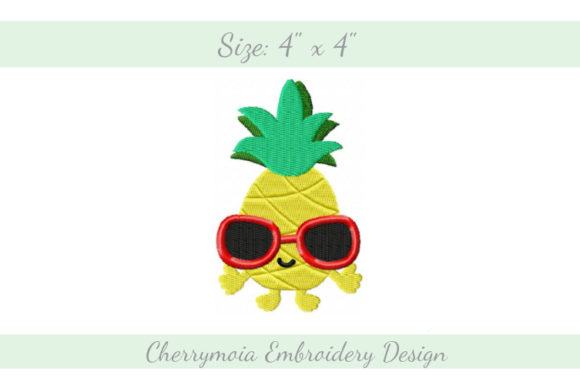
Cool Pineapple doesn’t try to be everything at once. It’s not overly detailed like an applique design with layered leaves and shadow stitches, nor is it so minimal it disappears on textured fabric. Instead, it uses clean satin stitch outlines for the pineapple’s ridges, balanced fill stitch sections for body definition, and subtle running stitch accents for leaf texture—just enough to read clearly at 3–4 inches wide. The shape sits comfortably in a vertical oval, making it ideal for center-chest placements on sweatshirts or pocket areas on aprons and tote bags. Visually, it reads as sunny and friendly—not cartoonish, not sterile. That matters when you’re building brand consistency for a small shop or crafting personalized gifts where tone equals trust.
Where Cool Pineapple Shines (and Where It Needs Care)
I used Cool Pineapple on a custom-ordered embroidered pillow cover for a coastal-themed nursery—and it landed perfectly. The stitch density is moderate: dense enough to prevent fabric show-through on light linens, but open enough to avoid stiffness or puckering on soft knits. On the onesie, I paired it with tear-away stabilizer and a size 75/11 needle; no skipped stitches, no thread breaks. That’s rare for a design with curved satin stitch edges.
But here’s where realism kicks in: Cool Pineapple isn’t magic. On dark fabric, especially charcoal or navy terry cloth, I swapped to high-contrast thread—bright yellow for the fruit, deep green for leaves—to maintain legibility. On stretchy fabric like jersey, I added cutaway stabilizer underneath *and* topped with a light film tear-away—critical for keeping those smooth satin stitch curves from distorting. And on curved surfaces like caps? I’d hesitate unless using a cap frame and reducing the design height by ~15%—not because the file can’t handle it, but because the original layout assumes flat hooping. Always test the design on scrap fabric first, especially if you’re stitching for commercial embroidery or Etsy listings where consistency is non-negotiable.
Real-World Fit: More Than Just “Summer Vibes”
This isn’t just a holiday embroidery filler. Cool Pineapple works because it’s versatile *without* being vague. It reads well on baby embroidery (think onesies, burp cloths, or crib bumper accents), adds personality to kitchen towels without overwhelming them, and gives small shop products—like handmade aprons or boutique tea towel sets—a cohesive, ownable identity. As an Etsy seller, I’d pair it with neutral backgrounds and simple typography in my printable mockups to highlight its clarity. As a craft fair vendor, I’d use it on limited-run embroidered patches—its clean lines translate beautifully when heat-applied to denim jackets or canvas backpacks.
It also avoids the trap many tropical designs fall into: looking dated after three seasons. There’s no glitter effect, no over-rendered gradients, no trendy font integration. Just strong silhouette, intentional spacing, and smart stitch choices. That means your finished product feels timeless—not seasonal—and customers are more likely to tag your shop in their Instagram stories or gift your items with confidence.
Design Notes You’ll Actually Use
Before stitching Cool Pineapple into your next project, here’s what I recommend:
- Test on scrap fabric—especially if using textured weaves, terry, or lightweight cotton voile.
- Check thread color contrast across light and dark backgrounds. Yellow-on-white reads cheerfully; yellow-on-khaki reads muted. Adjust accordingly.
- Review stitch density visually in your embroidery software. Look for tight clusters near leaf tips—if they’re too dense, consider slight manual reduction (but only if your machine handles editing reliably).
- Confirm hoop size compatibility. This design fits comfortably in a 4x4 hoop, but double-check before loading—some versions may push slightly beyond.
- Inspect small details in black-and-white mockups. Does the pineapple crown still read as distinct? Does the base anchor cleanly? If not, adjust underlay or stabilizer choice.
- Use proper stabilizer: tear-away for stable wovens, cutaway for knits or anything that will be washed frequently (like baby embroidery or kitchen towels).
- Verify licensing before selling finished items or bundling Cool Pineapple as part of a digital product. This is a digital embroidery file only—you need an embroidery machine to use it, and quality isn’t guaranteed if resized or altered.
Final Thought: It’s Not Just a Design—It’s a Craft Business Asset
Cool Pineapple earns its place in my working library because it delivers on two things makers care about most: reliability and resonance. It stitches cleanly, photographs well, scales naturally across product types (tote bag design, sweatshirt embroidery, embroidered patch), and carries a mood—summer ease, gentle fun, handmade warmth—without leaning on cliché. For creative entrepreneurs building a recognizable line, that kind of consistency is gold. For hobbyists stitching personalized gifts, it’s the kind of design that makes recipients smile *and* notice the craftsmanship. And for anyone tired of downloading files that look great on screen but fray, pucker, or vanish on fabric? Cool Pineapple is a quiet win—practical, polished, and ready for real work.