No Faux Cross Stitch with Floral Border
A Designer’s First Look: Charm with Quiet Confidence
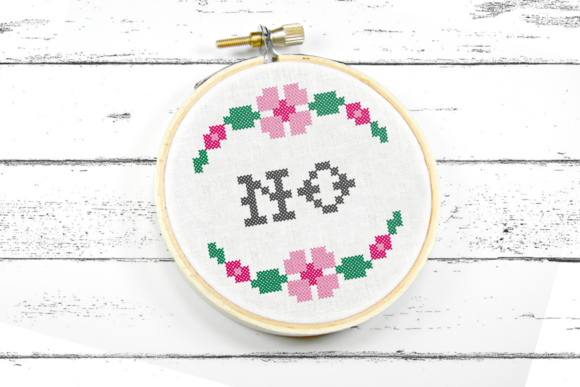
When I opened No Faux Cross Stitch with Floral Border, I didn’t see just another floral wreath — I saw a deliberate pause. That bold “NO” centered in a delicate, hand-drawn-style floral frame immediately reads as intentional, not ironic. It’s got the warmth of cross stitch but none of the time sink — a machine embroidery design that leans into craftiness without pretending to be hand-stitched. The floral border feels cohesive, not cluttered: petals are distinct but not fussy, vines curl gently, and spacing gives breathing room around the lettering. This isn’t background filler. It’s a statement piece dressed in garden gloves.
Real Project Test: Embroidering It on a Linen Tote Bag
Last week, I stitched No Faux Cross Stitch with Floral Border onto a natural linen tote for a local boutique’s spring collection. Why linen? Because it’s unforgiving — shows skipped stitches, puckering, and thread tension flaws instantly. I used medium tear-away stabilizer, 40-weight cotton thread, and kept my hoop snug but not over-tightened. The result? Crisp satin-stitch outlines on the florals, clean fill-stitch areas without shadowing, and that “NO” holding its shape beautifully at 3.5 inches wide. Customers paused mid-aisle. Not because it was loud — but because it felt *considered*. That’s the quiet power of this embroidery file: it elevates everyday items without shouting.
Where It Shines (and Where It Needs Care)
No Faux Cross Stitch with Floral Border excels in projects where personality meets practicality:
- Custom apparel: Works cleanly on sweatshirt cuffs, pocket flaps, or back yokes — especially when paired with tonal thread on heather gray or oatmeal fabric.
- Personalized gifts: A baby onesie with “NO” replaced by “YES” (via simple digitizing tweak) makes a witty nursery staple. Just confirm your editing software allows safe letter swaps.
- Small shop products: As an embroidered patch or tea towel design, it reads well at 4–5 inches — large enough to read, small enough to feel curated.
- Holiday and wedding embroidery: Swap thread colors to sage + ivory for a rustic bridal shower towel, or crimson + gold for a cheeky Christmas kitchen set.
But it’s not universally forgiving. Avoid using it on:
- Thin or highly stretchy fabrics (like lightweight jersey) without cut-away stabilizer and reduced stitch density — those floral stems can distort.
- Caps or curved surfaces unless you’ve tested it first on a similar cap blank; the symmetry relies on flat tension.
- Dark fabric with light thread unless you add a white underlay — some inner petal details vanish without contrast.
- Hoop sizes smaller than recommended — corners of the floral border may clip or compress if forced into tight spaces.
What It Adds to Your Handmade Product — Beyond Aesthetics
This isn’t just decoration. No Faux Cross Stitch with Floral Border quietly raises perceived value. On an Etsy listing, it signals intentionality — buyers scroll past generic florals but stop for something with wit and balance. For craft fair shoppers, it reads as “designed, not downloaded.” That matters for trust. When customers see consistent, confident execution — clean corners, even stitch coverage, thoughtful scale — they assume the same care went into fabric sourcing, seam finishing, and packaging. It also strengthens brand consistency: use it across tote bags, aprons, and pillow covers in the same thread palette, and your small shop starts feeling like a collection, not a catalog.
Designer Notes You’ll Actually Use
Before stitching No Faux Cross Stitch with Floral Border on your next project, do these five things:
- Test on scrap fabric first — especially if using textured weaves (burlap, terry cloth) or blends (cotton-poly). Watch how the floral vines settle into the grain.
- Check thread color contrast in natural light — what looks balanced on screen can mute on oatmeal linen or bleed on navy denim.
- Review stitch density in your embroidery software. If it’s dense near the “NO,” consider slightly reducing density in fill areas for better drape on apparel.
- Confirm hoop size before hooping — don’t assume it fits your standard 4x4 if the floral border extends beyond center.
- Inspect small details at 200% zoom: look for stray running stitches, overlapping nodes, or tiny gaps between petals and stem. Clean digitizing saves hours on re-hooping.
Also: test it in black-and-white mockups. Does the shape hold up without color? Does the “NO” retain weight? And always verify licensing — if you’re selling finished products or bundling it as part of digital embroidery assets, make sure commercial use is explicitly permitted.
Final Thought: A Design That Earns Its Place
No Faux Cross Stitch with Floral Border doesn’t try to be everything. It’s not a sprawling monogram, a dense applique design, or a minimalist line art piece. It’s a focused, floral-wreath-style embroidery file with presence — one that works as hard on a baby blanket as it does on a boutique sweatshirt. It respects the viewer’s intelligence, honors the handmade product ethos, and delivers real-world performance when treated with basic embroidery discipline. For Etsy sellers building a signature look, for crafters who want wit without whimsy, and for designers tired of chasing trends — this is the kind of embroidery project that quietly becomes a staple.